This tutorial uses the NSFW Detect API. See the docs, live demo, and pricing.
Your platform accepts user-uploaded images. You need to filter out inappropriate content before it reaches other users. Two options: install NudeNet, the most popular open-source NSFW detection library (2,300+ GitHub stars, MIT-like license), or call a cloud NSFW detection API that handles everything server-side. This guide tests both on the same images and compares what they catch, what they miss, and what it costs to run each in production. The cloud option is the NSFW Detect API, which covers 10 moderation categories beyond nudity.
Quick Comparison
| Criteria | NSFW Detect API | NudeNet (Open Source) |
|---|---|---|
| Categories | 10 (nudity, violence, drugs, alcohol, tobacco, gambling, hate symbols, rude gestures, suggestive, visually disturbing) | 1 (nudity only) |
| Label granularity | Hierarchical (parent + child + sub-child, 3 taxonomy levels) | Flat (body part labels with bounding boxes) |
| Setup | API key (5 minutes) | pip install nudenet (+ ONNX runtime, ~7MB model download) |
| GPU required | No | No (ONNX CPU), but faster with GPU |
| Accuracy (benchmarks) | 93-98% across categories | ~90% on nudity (academic study) |
| License | Commercial (pay per call) | AGPL-3.0 |
| Scaling | Handled by the API | You manage servers and queuing |
What NudeNet Does
NudeNet is a Python library that detects nudity in images. Version 3 (current) uses ONNX Runtime instead of TensorFlow, which makes it lighter and faster to install. The default model is about 7MB.
from nudenet import NudeDetector

detector = NudeDetector()
results = detector.detect("photo.jpg")

for detection in results:
    print(f"{detection['class']}: {detection['score']:.3f}")
    # FEMALE_BREAST_EXPOSED: 0.787
    # FACE_FEMALE: 0.736
NudeNet returns a list of detections, each with a class name (body part + exposed/covered), a confidence score, and a bounding box. It can also censor detected regions with detector.censor("photo.jpg").
The detection classes are all body-part based: exposed/covered variants of breasts, buttocks, genitalia, belly, feet, armpits, and face (classified as male or female). There are no classes for violence, drugs, alcohol, gambling, or any non-nudity content.
What the NSFW Detection API Does
The NSFW Detect API classifies images across 10 top-level categories, each with hierarchical sub-labels. You send an image, get back a list of moderation labels with confidence scores.
import requests

url = "https://nsfw-detect3.p.rapidapi.com/nsfw-detect"
headers = {
    "x-rapidapi-host": "nsfw-detect3.p.rapidapi.com",
    "x-rapidapi-key": "YOUR_API_KEY",
}

with open("photo.jpg", "rb") as f:
    response = requests.post(url, headers=headers, files={"image": f})

labels = response.json()["body"]["ModerationLabels"]
for label in labels:
    print(f"{label['Name']}: {label['Confidence']:.1f}% (parent: {label['ParentName']})")
    # Drugs & Tobacco: 99.4% (parent: )
    # Smoking: 99.4% (parent: Drugs & Tobacco)
The response uses a 3-level taxonomy. A top-level label like "Drugs & Tobacco" has children like "Drugs & Tobacco Paraphernalia & Use", which has sub-children like "Smoking". This lets you set different thresholds per category: strict on nudity (block at 50%), lenient on suggestive content (block at 90%).
Testing Both on the Same Images
We tested both tools on three images. All images are from Pexels (free stock photos) and contain no explicit content. The goal: see how each tool handles non-nudity NSFW categories and edge cases.
Test 1: Male shirtless photo
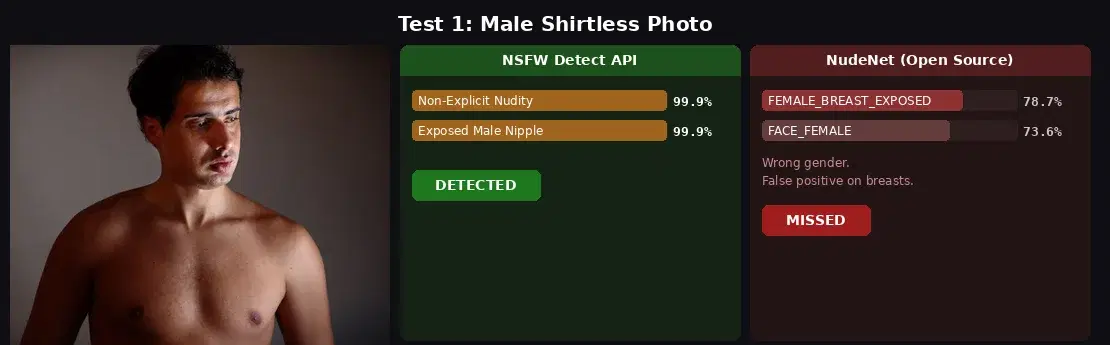
- API: Non-Explicit Nudity (99.9%), Exposed Male Nipple (99.9%). Correct category, correct gender.
- NudeNet: FEMALE_BREAST_EXPOSED (78.7%), FACE_FEMALE (73.6%). Wrong gender on both detections. The image shows a man, not a woman.
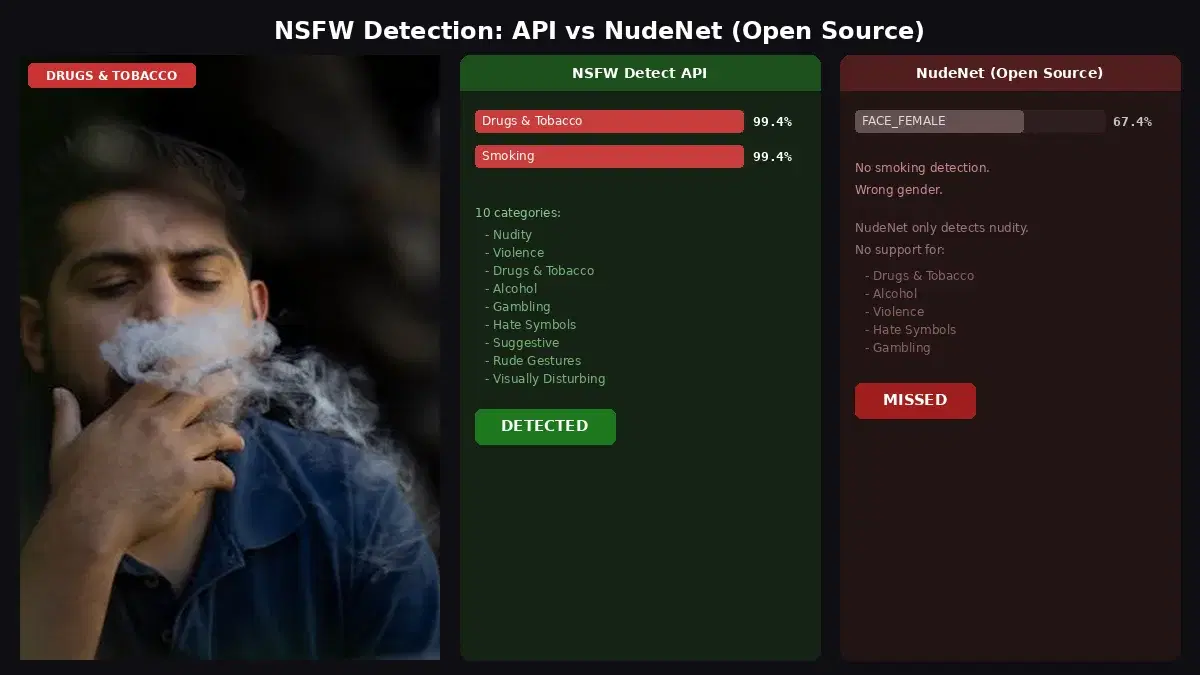
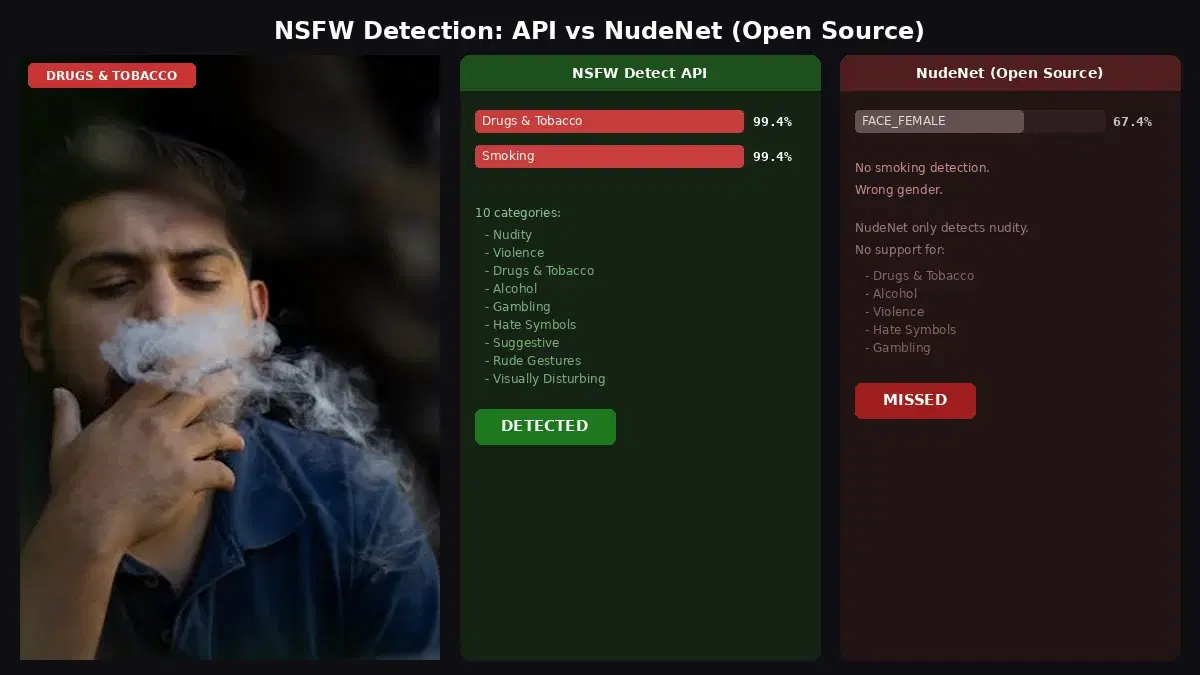
Test 2: Smoking photo
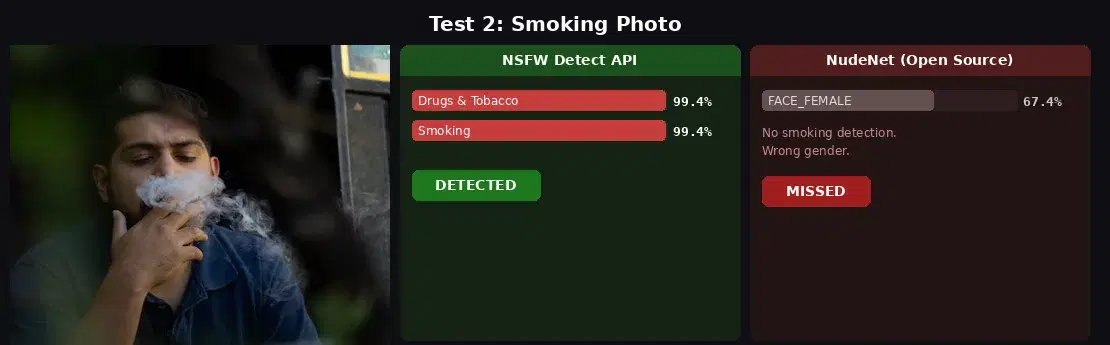
- API: Drugs & Tobacco (99.4%), Smoking (99.4%). Correctly identifies the smoking activity.
- NudeNet: FACE_FEMALE (67.4%). No smoking detection at all. Also misclassifies the male face as female.
Test 3: Alcohol photo
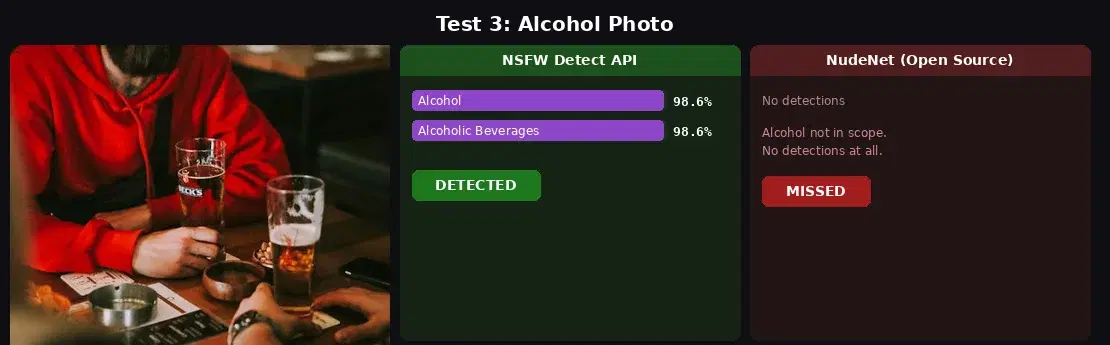
- API: Alcohol (98.6%), Alcoholic Beverages (98.6%). Identifies the beer glasses on the table.
- NudeNet: No detections. Alcohol is not in NudeNet's scope.
The Category Gap
The test results illustrate the fundamental difference. NudeNet is a nudity detector. The API is a content moderator. If your platform only needs to block explicit nudity (a porn filter), NudeNet works. If you need to catch tobacco, alcohol, violence, hate symbols, or gambling content, NudeNet has zero coverage.
Here are the 10 categories the API covers:
- Explicit Nudity
- Non-Explicit Nudity (swimwear, partial exposure)
- Suggestive content
- Violence
- Visually Disturbing
- Drugs & Tobacco
- Alcohol
- Gambling
- Hate Symbols
- Rude Gestures
For platforms with advertising revenue, brand safety requires all 10. An advertiser won't care that your filter catches nudity if their ad appears next to a photo of someone smoking or holding a weapon.
When to Choose NudeNet
- Nudity-only filtering. If explicit nudity is your only concern (adult site age gate, basic upload filter), NudeNet covers it.
- Offline or air-gapped environments. NudeNet runs entirely on your machine. No API calls, no network dependency.
- Privacy-critical workloads. Images never leave your server. For industries like healthcare or government where data residency matters, self-hosted is the only option.
- Budget with existing infrastructure. If you already have GPU servers and only process a few thousand images per day, running NudeNet is essentially free after the infrastructure cost.
When to Choose the API
- Multi-category moderation. Drugs, alcohol, violence, hate symbols, gambling. If you need more than nudity, NudeNet can't help.
- Brand safety. Advertising platforms need all 10 categories to protect ad placement. One missed tobacco photo next to a health brand ad is a lost client.
- Scale without infrastructure. The API handles concurrency and scaling. You don't manage GPU servers, model updates, or monitoring dashboards.
- Hierarchical filtering. The 3-level taxonomy lets you set different thresholds per category. Block explicit nudity at 50% confidence but only flag suggestive content at 90%.
- Compliance. Content regulations vary by market. A content moderation API that covers violence, drugs, and hate symbols helps meet platform obligations under laws like the EU Digital Services Act.
Running NudeNet in Production
Tutorials make NudeNet look simple: pip install nudenet, call detect(), done. In production, there are complications the tutorials don't mention:
- AGPL-3.0 license. NudeNet uses AGPL, which requires you to open-source your application if you distribute it. For SaaS platforms, this is a legal grey area. Check with your legal team.
- ONNX model loading. The first call loads the model into memory (~500ms cold start). In a serverless or container environment, this adds latency on every new instance.
- No model updates. NudeNet's model was last updated in 2023. New types of NSFW content (AI-generated, new trends) may not be caught. Cloud APIs update models silently.
- Gender accuracy. Our tests showed NudeNet misclassifying male subjects as female on 2 out of 3 images. If you use gender labels for filtering logic, this causes false positives and false negatives.
Code: Test Both on Your Images
Run both tools on the same image and compare the results yourself.
NudeNet
from nudenet import NudeDetector

detector = NudeDetector()

results = detector.detect("test_image.jpg")
if results:
    for r in results:
        print(f"  {r['class']}: {r['score']:.1%}")
else:
    print("  No detections")
NSFW Detect API (cURL)
curl -X POST \
  'https://nsfw-detect3.p.rapidapi.com/nsfw-detect' \
  -H 'x-rapidapi-host: nsfw-detect3.p.rapidapi.com' \
  -H 'x-rapidapi-key: YOUR_API_KEY' \
  -F 'image=@test_image.jpg'
NSFW Detect API (Python)
import requests

url = "https://nsfw-detect3.p.rapidapi.com/nsfw-detect"
headers = {
    "x-rapidapi-host": "nsfw-detect3.p.rapidapi.com",
    "x-rapidapi-key": "YOUR_API_KEY",
}

with open("test_image.jpg", "rb") as f:
    response = requests.post(url, headers=headers, files={"image": f})

labels = response.json()["body"]["ModerationLabels"]
if labels:
    for label in labels:
        print(f"  {label['Name']}: {label['Confidence']:.1f}%")
else:
    print("  No inappropriate content detected")
NSFW Detect API (JavaScript)
const fs = require("fs");
const FormData = require("form-data");

const form = new FormData();
form.append("image", fs.createReadStream("test_image.jpg"));

const response = await fetch(
  "https://nsfw-detect3.p.rapidapi.com/nsfw-detect",
  {
    method: "POST",
    headers: {
      "x-rapidapi-host": "nsfw-detect3.p.rapidapi.com",
      "x-rapidapi-key": "YOUR_API_KEY",
      ...form.getHeaders(),
    },
    body: form,
  }
);

const data = await response.json();
data.body.ModerationLabels.forEach((label) => {
  console.log(`${label.Name}: ${label.Confidence.toFixed(1)}%`);
});
Sources
- NudeNet GitHub Repository - official source, AGPL-3.0 license, 2.3K stars
- A Comparative Study of Tools for Explicit Content Detection in Images (2023) - academic benchmark: NudeNet ~90% accuracy, NSFW models ~93%
- NudeNet on PyPI - v3.4.2, ONNX runtime, Python 3.8+
NudeNet is a solid open-source tool for nudity-only filtering. If that's all you need, it works. But content moderation on production platforms requires more than nudity detection. Drugs, alcohol, violence, hate symbols, and gambling content all need coverage, and NudeNet doesn't touch any of them. The NSFW Detect API covers all 10 categories with hierarchical labels, handles scaling, and updates models without any work on your end. For related approaches, see the NSFW blur tutorial and the cloud NSFW APIs comparison.
Frequently Asked Questions
- What categories can NudeNet detect?
- NudeNet detects nudity only. It classifies exposed and covered body parts (breasts, buttocks, genitalia, belly, feet, armpits, face) and returns bounding boxes with confidence scores. It does not detect violence, drugs, alcohol, hate symbols, gambling, or other non-nudity NSFW categories.
- How accurate is NudeNet compared to a cloud NSFW detection API?
- Academic benchmarks show NudeNet achieves about 90% accuracy on nudity detection. Cloud APIs that use multi-model pipelines typically score higher (93-98%) and cover more categories. In our tests, NudeNet also misclassified gender on two out of three test images.
- Does NudeNet require a GPU?
- No. NudeNet v3 runs on ONNX Runtime, which works on CPU. The default model is about 7MB. Processing is slower without a GPU (100-300ms per image on CPU vs under 50ms on GPU), but it works on any machine with Python 3.8+.