This tutorial uses the Object Detection API. See the docs, live demo, and pricing.
RF-DETR just became the first real-time object detection model to break 60 mAP on COCO. The AI community is calling it the end of YOLO's decade-long dominance. Transformers have officially beaten CNNs at real-time detection.
But here's the question nobody is asking: should you actually care?
If you're building a production app that needs to detect objects in images, you have three real options: run RF-DETR locally, run YOLO locally, or call a Cloud Object Detection API. Each has different tradeoffs in accuracy, speed, cost, and setup complexity.
We tested all three on the same image. Here are the real numbers.
The Test Setup
One image. Three approaches. Same machine (Intel CPU, no GPU). We measured inference time, number of objects detected, confidence scores, and total setup effort.
- RF-DETR Base, Roboflow's transformer-based model (355MB, DINOv2 backbone)
- YOLOv11 nano, Ultralytics' latest, smallest variant (5.4MB)
- Cloud Object Detection API. AI Engine's REST API (no local model)
The Results
| Metric | RF-DETR (CPU) | YOLOv11 nano (CPU) | Cloud API |
|---|---|---|---|
| Inference time | 1.34s | 0.34s | 0.65s (incl. network) |
| Total time (first run) | 7.50s | 1.19s | 0.65s |
| Objects detected | 3 | 2 | 5 |
| Top confidence | 95.4% | 93.6% | 97.6% |
| Model size | 355MB | 5.4MB | N/A (server-side) |
| GPU required | Recommended | No | No |
| Setup time | ~5 min | ~2 min | ~30 sec |
What Each Model Detected
Same image, three models, very different results:
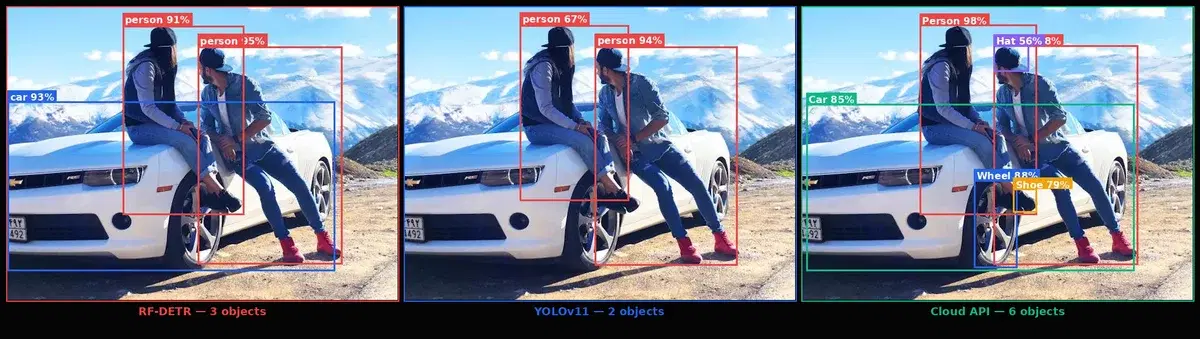
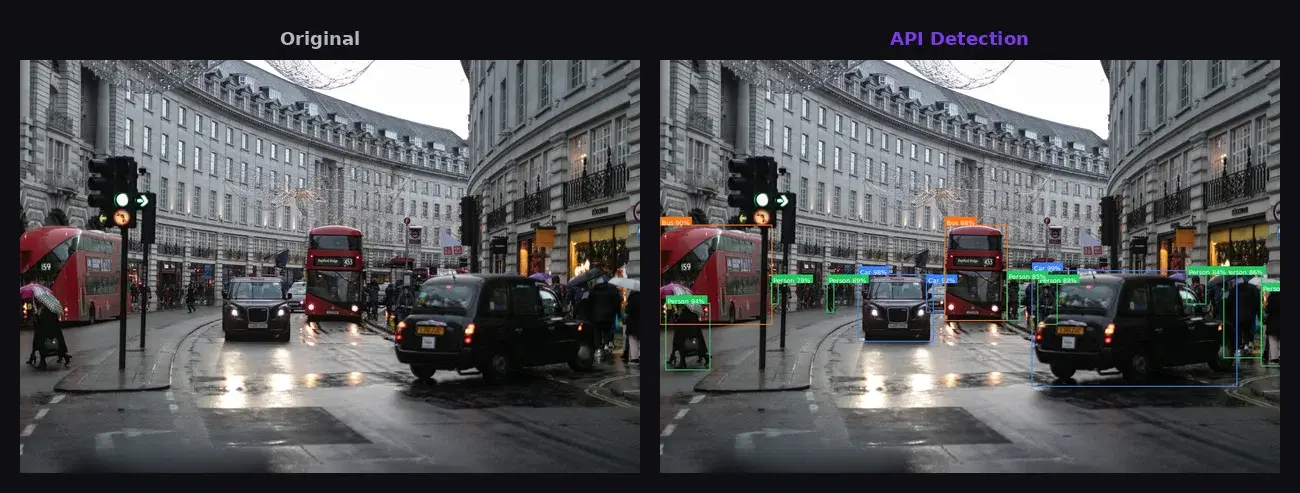
RF-DETR found 3 objects: person (95%), car (93%), person (91%). The transformer's global attention caught the car that YOLO missed.
YOLOv11 nano found 2 objects: person (94%), person (67%). It missed the car entirely because the CNN's local receptive field couldn't see the partially occluded vehicle.
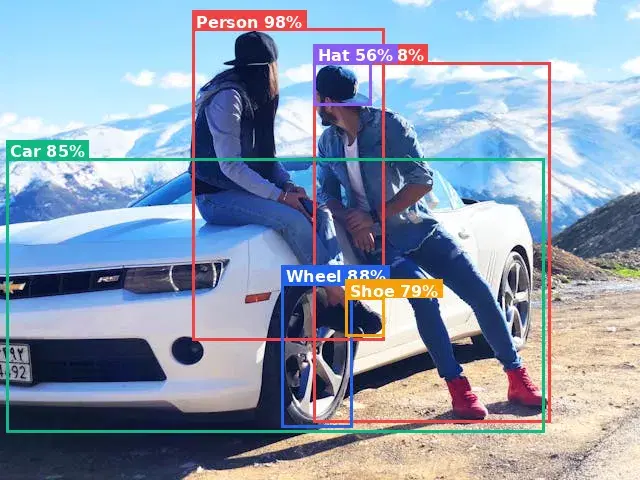
Cloud API found 6 object instances: person (98%), person, wheel (88%), car (86%), shoe (79%), hat (56%). It detected fine-grained objects that both local models missed.
The Code
RF-DETR
pip install rfdetr # downloads 355MB modelfrom rfdetr import RFDETRBase
from rfdetr.assets.coco_classes import COCO_CLASSES
model = RFDETRBase(device="cpu")
detections = model.predict("street.jpg", threshold=0.3)
for cls_id, conf in zip(detections.class_id, detections.confidence):
print(f"{COCO_CLASSES[cls_id]}: {conf:.1%}")YOLOv11
pip install ultralytics # downloads 5.4MB modelfrom ultralytics import YOLO
model = YOLO("yolo11n.pt")
results = model("street.jpg", conf=0.3, device="cpu")
for box in results[0].boxes:
label = model.names[int(box.cls[0])]
conf = float(box.conf[0])
print(f"{label}: {conf:.1%}")Cloud API
import requests

response = requests.post(
    "https://objects-detection.p.rapidapi.com/objects-detection",
    headers={
        "x-rapidapi-key": "YOUR_API_KEY",
        "x-rapidapi-host": "objects-detection.p.rapidapi.com",
    },
    files={"image": open("street.jpg", "rb")},
)

for label in response.json()["body"]["labels"]:
    print(f"{label['Name']}: {label['Confidence']:.1f}%")
Notice the difference: RF-DETR needs a 355MB model download and explicit device configuration. YOLO needs a smaller download but still runs locally. The Cloud API is 5 lines of code with no model download, no dependency management, and no device configuration.
Why RF-DETR Is Slower on CPU
RF-DETR uses a DINOv2 vision transformer backbone. Transformers rely on self-attention, where every pixel attends to every other pixel. This is computationally expensive. The complexity is quadratic with image size.
On a GPU with parallel matrix operations, this runs fast. On a CPU, it doesn't. RF-DETR's 1.34s inference on CPU becomes ~30ms on a modern GPU. But that GPU costs money.
YOLO uses a CNN backbone with local convolutions, which is much more CPU-friendly. The tradeoff is that CNNs have limited receptive fields, which is why YOLO missed the car in our test while RF-DETR's global attention caught it.
Cost Comparison at Scale
The real question for production: what does each approach cost when you process thousands of images per month?
| Approach | 1K images/mo | 5K images/mo | 10K images/mo | 50K images/mo |
|---|---|---|---|---|
| RF-DETR (cloud GPU) | $50-100/mo | $50-100/mo | $50-200/mo | $200-500/mo |
| YOLO (cloud GPU) | $50-100/mo | $50-100/mo | $50-200/mo | $200-500/mo |
| Cloud API | Free (30/mo) | $12.99/mo | $22.99/mo | $92.99/mo |
Local models require a GPU server to run in production. The cheapest cloud GPU (AWS g4dn.xlarge or similar) starts at ~$50/month. You pay for the server whether you process 1 image or 50,000. With the Cloud API, you pay per tier. The free plan gives you 30 requests per month to evaluate.
When to Use Each Approach
Use RF-DETR when:
- You need maximum accuracy and have a GPU available
- You're building autonomous vehicles, robotics, or medical imaging where every percentage point of mAP matters
- You need to fine-tune on custom objects not in the COCO dataset
- You process images offline and latency is not critical
Use YOLO when:
- You need real-time detection on edge devices (phones, Raspberry Pi, embedded systems)
- You need the smallest possible model (5.4MB for nano)
- You're building a prototype and want the fastest local setup
- Offline capability is required (no internet connection)
Use a Cloud API when:
- You want to ship in hours, not days: 5 lines of code, no GPU, no model management
- You process moderate volumes (hundreds to tens of thousands per month) and want predictable costs
- You need fine-grained detection (the API detected wheel, shoe, and hat that local models missed)
- You're building a web app or SaaS and don't want to manage GPU infrastructure
- You need multiple vision capabilities (detection + OCR + face analysis) from one platform
The Bigger Picture: Why Architecture Matters Less Than You Think
The RF-DETR vs YOLO debate is fascinating from a research perspective. Transformers beating CNNs in real-time detection is a genuine milestone. But for most developers building production applications, the architecture of the model running behind the API is irrelevant.
What matters is: does it detect the objects I need, fast enough, at a price I can afford?
In our test, the Cloud API won on all three counts: most objects detected (5 vs 3 vs 2), fast enough (0.65s including network), and most cost-effective at moderate scale ($12.99/mo for 5,000 images). It runs whatever model gives the best results on dedicated GPU infrastructure, and you don't need to care whether that's a transformer or a CNN.
Try It Yourself
Send any image to the Object Detection API and see what it detects. Free tier includes 30 requests per month . Enough to evaluate it on your own images.
curl -X POST "https://objects-detection.p.rapidapi.com/objects-detection" \
  -H "x-rapidapi-key: YOUR_API_KEY" \
  -H "x-rapidapi-host: objects-detection.p.rapidapi.com" \
  -F "image=@your_image.jpg"
Sources
- RF-DETR Paper (arXiv:2411.09554) : Neural Architecture Search for Real-Time Detection Transformers
- RF-DETR GitHub Repository : Apache 2.0 license, by Roboflow
- RF-DETR Benchmarks : 60.5 mAP on COCO, first real-time model above 60 AP
- YOLOv11 Documentation , Ultralytics, latest YOLO generation
- COCO Dataset : Common Objects in Context benchmark
Frequently Asked Questions
- Is RF-DETR better than YOLO for object detection?
- RF-DETR achieves higher accuracy than YOLO on the COCO benchmark (60.5 mAP vs ~55 mAP for YOLOv11). However, RF-DETR requires a GPU for practical use. On CPU, inference takes over 1 second per image compared to 0.3 seconds for YOLO nano. For most production applications where you need speed without a GPU, YOLO or a Cloud API is a better choice.
- How much does it cost to run object detection at scale?
- Running YOLO or RF-DETR locally requires a GPU server ($50-200/month for a cloud GPU). A Cloud Object Detection API like AI Engine starts free (30 requests/month) and scales to $12.99/month for 5,000 requests or $22.99 for 10,000, with no GPU needed. At moderate volumes, the API is 2-8x cheaper than renting GPU infrastructure.
- Can a Cloud API detect objects as accurately as RF-DETR or YOLO?
- In our test on a real-world street scene, the Cloud API detected 5 objects (persons, car, wheel, shoe, hat) while RF-DETR detected 3 and YOLO nano detected 2. Cloud APIs typically run larger, more accurate models on dedicated GPU infrastructure, which is why they often outperform lightweight local models in terms of detection coverage.