This tutorial uses the Emotion & Personality Analysis API. See the docs, live demo, and pricing.
Every piece of text carries more than its literal meaning. A product review, a support ticket, or a social media post is layered with emotions, attitudes, and personality signals that shape how it should be interpreted and acted upon. Extracting those signals manually is impractical at scale, but a purpose-built emotion detection API and sentiment analysis API can decode the emotional and psychological dimensions of any text in milliseconds. In this guide you will learn how to integrate four powerful NLP endpoints into your applications, complete with working code in cURL, Python, and JavaScript.
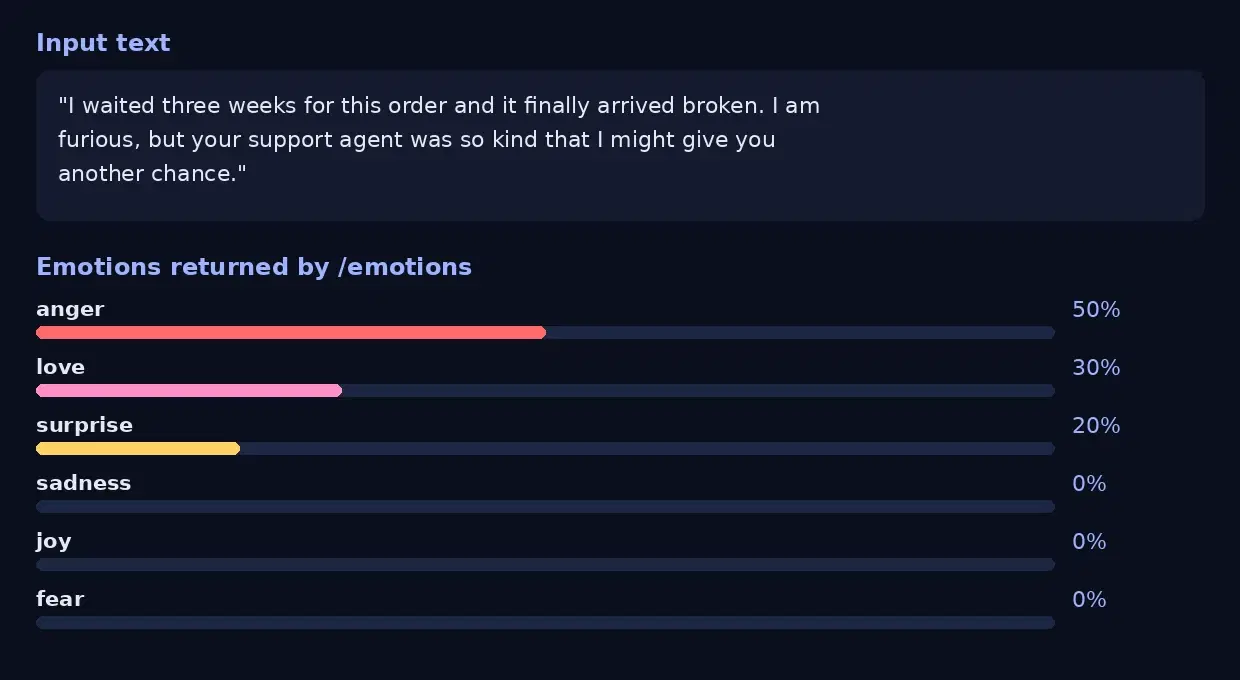
/emotions endpoint. A single review can carry conflicting feelings, and the API scores each one separately (anger 50%, love 30%, surprise 20%) instead of collapsing it to one label.Why Analyze Emotions in Text?
Raw text data is abundant, but understanding the human feelings behind it is what turns data into actionable insight. Here is why emotion and sentiment analysis matters across teams and products:
- Better user experience: Detect frustration or confusion in real time and adapt your interface, messaging, or support routing accordingly. When your product responds to how users feel, not just what they type, engagement and satisfaction climb.
- Smarter marketing: Measure emotional resonance across campaigns, ad copy, and landing pages. Know whether your audience feels excitement, trust, or indifference before you scale spending.
- Faster customer support: Automatically prioritize angry or distressed tickets so agents handle the most urgent cases first. Pair sentiment scores with routing rules and you cut average resolution time while improving customer retention.
- Data-driven product decisions: Aggregate emotion signals from thousands of reviews or feedback entries to surface patterns that keyword searches miss. A product might get five-star ratings but still carry undertones of disappointment about a specific feature.
4 Endpoints, 1 Subscription
The Emotion & Sentiment Analysis API bundles four distinct NLP capabilities under a single subscription. Each endpoint accepts a JSON body with a text field and returns structured, scored results:
- /emotions: Detects fine-grained emotions like joy, anger, sadness, fear, surprise, and disgust with individual confidence scores.
- /sentiment: Classifies overall sentiment as positive, negative, or neutral and returns per-class probability scores.
- /personality: Infers Big Five personality traits (openness, conscientiousness, extraversion, agreeableness, neuroticism) from writing style.
- /communication: Identifies the communication style of the author, including formality level, tone, and whether the text is fact-oriented, emotion-oriented, or action-oriented.
This means you can build a complete text understanding pipeline without juggling multiple providers or API keys.
Getting Started
All four endpoints share the same base URL, headers, and request format. You need a RapidAPI key to authenticate. Replace YOUR_API_KEY in the examples below with your actual key from the API page.
Emotion Detection
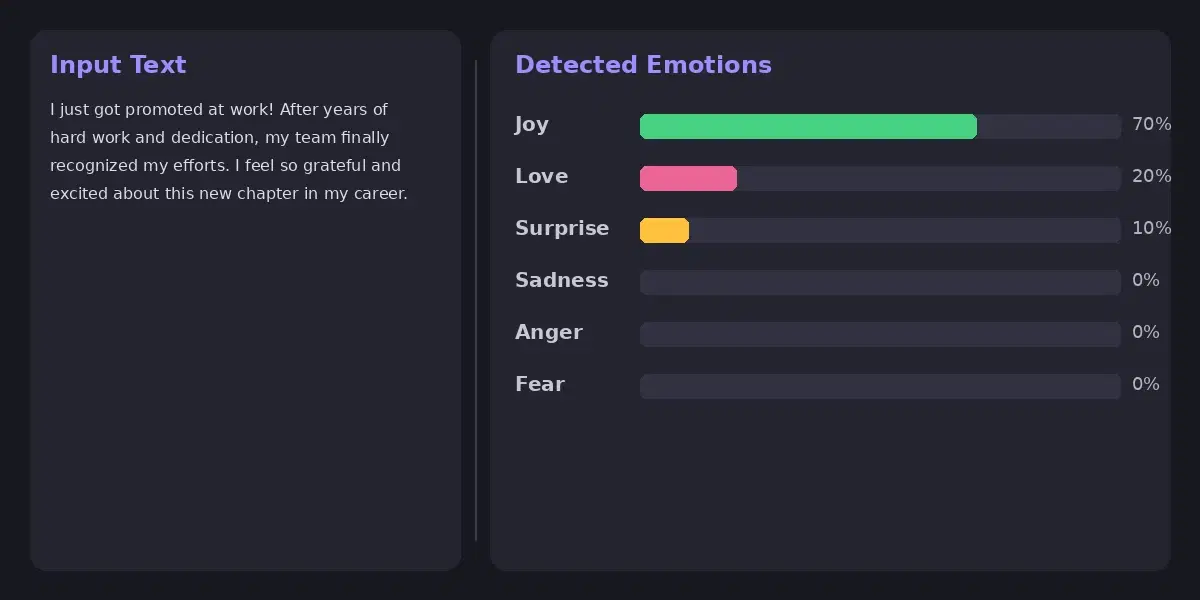
The /emotions endpoint returns an array of detected emotions with confidence scores. This is ideal for understanding the nuanced emotional makeup of a piece of text, since a single message can express multiple emotions simultaneously.
cURL
curl -X POST \
  'https://emotion-sentiment-personality-analysis.p.rapidapi.com/emotions' \
  -H 'Content-Type: application/json' \
  -H 'x-rapidapi-host: emotion-sentiment-personality-analysis.p.rapidapi.com' \
  -H 'x-rapidapi-key: YOUR_API_KEY' \
  -d '{
    "text": "I just got promoted! This is the best day of my life."
  }'
Example response:
{
  "emotions": [
    { "label": "joy", "score": 0.70 },
    { "label": "love", "score": 0.20 },
    { "label": "surprise", "score": 0.10 },
    { "label": "sadness", "score": 0.00 },
    { "label": "anger", "score": 0.00 },
    { "label": "fear", "score": 0.00 }
  ]
}
Python
import requests

url = "https://emotion-sentiment-personality-analysis.p.rapidapi.com/emotions"
headers = {
    "Content-Type": "application/json",
    "x-rapidapi-host": "emotion-sentiment-personality-analysis.p.rapidapi.com",
    "x-rapidapi-key": "YOUR_API_KEY",
}
payload = {
    "text": "I just got promoted! This is the best day of my life."
}

response = requests.post(url, json=payload, headers=headers)
data = response.json()

for emotion in data["emotions"]:
    print(f"{emotion['label']}: {emotion['score']:.2f}")
JavaScript (fetch)
const response = await fetch(
  "https://emotion-sentiment-personality-analysis.p.rapidapi.com/emotions",
  {
    method: "POST",
    headers: {
      "Content-Type": "application/json",
      "x-rapidapi-host": "emotion-sentiment-personality-analysis.p.rapidapi.com",
      "x-rapidapi-key": "YOUR_API_KEY",
    },
    body: JSON.stringify({
      text: "I just got promoted! This is the best day of my life.",
    }),
  }
);

const data = await response.json();
data.emotions.forEach((e) =>
  console.log(`${e.label}: ${e.score.toFixed(2)}`)
);
Sentiment Analysis
The /sentiment endpoint gives you a high-level positive, negative, or neutral classification along with granular probability scores for each class. Use this when you need a quick thumbs-up or thumbs-down signal rather than a full emotional breakdown.
cURL
curl -X POST \
  'https://emotion-sentiment-personality-analysis.p.rapidapi.com/sentiment' \
  -H 'Content-Type: application/json' \
  -H 'x-rapidapi-host: emotion-sentiment-personality-analysis.p.rapidapi.com' \
  -H 'x-rapidapi-key: YOUR_API_KEY' \
  -d '{
    "text": "The delivery was late and the product arrived damaged. Very disappointed."
  }'
Example response:
{
  "sentiment": {
    "label": "negative",
    "score": 0.85
  },
  "scores": {
    "positive": 0.05,
    "neutral": 0.10,
    "negative": 0.85
  }
}
Python
import requests

url = "https://emotion-sentiment-personality-analysis.p.rapidapi.com/sentiment"
headers = {
    "Content-Type": "application/json",
    "x-rapidapi-host": "emotion-sentiment-personality-analysis.p.rapidapi.com",
    "x-rapidapi-key": "YOUR_API_KEY",
}
payload = {
    "text": "The delivery was late and the product arrived damaged. Very disappointed."
}

response = requests.post(url, json=payload, headers=headers)
data = response.json()

label = data["sentiment"]["label"]
score = data["sentiment"]["score"]
print(f"Sentiment: {label} (confidence: {score:.2f}")

# Access individual class scores
for cls, val in data["scores"].items():
    print(f"  {cls}: {val:.2f}")
Personality Profiling
The /personality endpoint infers Big Five personality traits from the writing style of the input text. Longer texts produce more reliable results, so aim for at least a paragraph of natural writing. This is useful for tailoring marketing messages, personalizing chatbot responses, or segmenting users by communication preferences.
Python
import requests

url = "https://emotion-sentiment-personality-analysis.p.rapidapi.com/personality"
headers = {
    "Content-Type": "application/json",
    "x-rapidapi-host": "emotion-sentiment-personality-analysis.p.rapidapi.com",
    "x-rapidapi-key": "YOUR_API_KEY",
}
payload = {
    "text": "I love exploring new ideas and meeting people from different backgrounds. "
            "Planning ahead gives me peace of mind, though I also enjoy spontaneous adventures. "
            "I believe teamwork makes even the hardest problems manageable."
}

response = requests.post(url, json=payload, headers=headers)
data = response.json()

traits = data["personality"]
print("Big Five Personality Traits:")
print(f"  Openness:          {traits['openness']:.2f}")
print(f"  Conscientiousness: {traits['conscientiousness']:.2f}")
print(f"  Extraversion:      {traits['extraversion']:.2f}")
print(f"  Agreeableness:     {traits['agreeableness']:.2f}")
print(f"  Neuroticism:       {traits['neuroticism']:.2f}")
Example response:
{
  "personality": {
    "openness": 0.82,
    "conscientiousness": 0.75,
    "extraversion": 0.88,
    "agreeableness": 0.71,
    "neuroticism": 0.25
  }
}
Communication Style
The /communication endpoint classifies how the author communicates. It returns the dominant style (such as fact-oriented, emotion-oriented, or action-oriented), a confidence score, a formality rating, and the overall tone. This is especially valuable for adapting automated replies or coaching agents on how to respond to different writing styles.
Python
import requests

url = "https://emotion-sentiment-personality-analysis.p.rapidapi.com/communication"
headers = {
    "Content-Type": "application/json",
    "x-rapidapi-host": "emotion-sentiment-personality-analysis.p.rapidapi.com",
    "x-rapidapi-key": "YOUR_API_KEY",
}
payload = {
    "text": "According to our Q3 data, revenue grew 12% year-over-year. "
            "I recommend we allocate additional budget to the APAC region "
            "based on the conversion trends outlined in the attached report."
}

response = requests.post(url, json=payload, headers=headers)
data = response.json()

print(f"Style:      {data['style']}")
print(f"Confidence: {data['confidence']:.2f}")
print(f"Formality:  {data['formality']}")
print(f"Tone:       {data['tone']}")
Example response:
{
  "style": "fact-oriented",
  "confidence": 0.91,
  "formality": "formal",
  "tone": "collaborative"
}
Real-World Use Cases
The combination of emotion, sentiment, personality, and communication analysis opens up use cases that no single NLP endpoint could handle alone. Here are four high-impact scenarios.
Customer Support Triage
Feed incoming support tickets through the /emotions and /sentiment endpoints to automatically prioritize cases. Tickets expressing anger or strong negative sentiment get routed to senior agents or escalation queues, while neutral informational requests follow the standard flow. This reduces average response time for urgent issues and prevents frustrated customers from churning while they wait in a generic queue.
Product Review Analysis
Star ratings tell you whether customers are happy, but emotion detection tells you why. Run thousands of reviews through the /emotions endpoint to surface patterns like "joy about the design but fear about durability." Product teams can use these granular signals to prioritize roadmap items with far more precision than aggregate star averages allow. Pair this with the /sentiment endpoint to track overall brand health over time.
Chatbot Personalization
Use the /personality and /communication endpoints to adapt your chatbot or virtual assistant to each user. If the personality profile suggests high agreeableness and the communication style is emotion-oriented, the bot can respond with warmer, more empathetic language. If the user is fact-oriented and formal, the bot can switch to concise, data-driven responses. This kind of dynamic personalization increases user satisfaction and conversion rates in sales-oriented bots.
Social Media Monitoring
Track how your brand is perceived across social media by running mentions, comments, and replies through the sentiment and emotion endpoints. Build dashboards that show real-time shifts in public sentiment around product launches, PR events, or competitor moves. If a spike in negative sentiment is detected, your team can respond before a small issue becomes a full-blown crisis. For platforms that also handle user-generated images, consider pairing text analysis with automated content moderation to build a complete safety and monitoring pipeline.
Tips and Best Practices
Follow these guidelines to get the most accurate and reliable results from the API:
- Send enough text for reliable analysis. A single word or very short phrase does not provide enough signal for accurate emotion or personality inference. Aim for at least one to two complete sentences for emotion and sentiment, and a full paragraph or more for personality profiling.
- Clean your input text. Strip out HTML tags, excessive whitespace, and boilerplate signatures before sending text to the API. Noisy formatting can dilute the signal and skew confidence scores.
- Use thresholds, not just top labels. The API returns confidence scores for a reason. A sentiment score of 0.52 negative is very different from 0.95 negative. Define meaningful thresholds for your use case rather than blindly trusting the top label. For example, only trigger an escalation alert when the negative sentiment score exceeds 0.75.
- Combine endpoints for deeper insight. One endpoint gives one dimension; all four give a multidimensional profile of the author and the message. A customer can read as neutral in sentiment but high in neuroticism with an emotion-oriented style, a sign they need careful handling even when the words seem calm.
- Batch requests for high-volume pipelines. For thousands of reviews or posts, send requests in parallel with reasonable concurrency (ten to twenty at a time) instead of sequentially, keeping total time low while respecting rate limits. Use
asyncio+aiohttpin Python orPromise.allin JavaScript.
Understanding the emotions, sentiment, personality, and communication style behind text transforms raw data into genuine human insight. Whether you are building smarter support systems, personalizing chatbot interactions, or monitoring brand perception at scale, the Emotion & Sentiment Analysis API gives you four powerful NLP endpoints under a single subscription. Head over to the API page to get your key and start analyzing text today.
Frequently Asked Questions
- What is an emotion detection API?
- An emotion detection API analyzes text and identifies the emotions expressed in it - such as joy, sadness, anger, fear, or surprise. It returns confidence scores for each emotion, enabling applications like customer feedback analysis, social media monitoring, and mental health tools.
- What is the difference between emotion detection and sentiment analysis?
- Sentiment analysis classifies text as positive, negative, or neutral - a broad polarity measure. Emotion detection is more granular: it identifies specific emotions like joy, anger, sadness, or fear. Emotion detection gives you richer insights into how people actually feel.
- Can an emotion API analyze multiple emotions in one text?
- Yes. A single text can express multiple emotions simultaneously. The API returns confidence scores for each emotion category, so you can see that a customer review expresses both frustration (anger: 0.7) and hope (joy: 0.3) at the same time.